Last week I sat down for a 1:1 with someone on my team and realized, about two minutes in, that I had no memory of what we'd talked about the week before. Not the specifics, not the tone, nothing useful. I'd had the conversation. I just hadn't held onto it.
That gap is what management reflection closes. It's the practice of regularly writing down what's happening in your work as a leader: how you handled a conversation, why a meeting went sideways, what a team member needs that you haven't addressed. Not journaling in the broad sense. Something more focused than that.
Why reflection compounds over time
One entry by itself doesn't tell you much. But a week of entries starts showing you things. A month of them shows you which situations reliably drain you, which people need more context than you've been giving them, and which decisions you keep circling back to because you never actually made them.
That's the real payoff. Not any single insight, but the pattern recognition that only works when you have a written record to look across. Your memory won't do this for you. Research on the Ebbinghaus forgetting curve shows that people forget roughly 70% of new information within 24 hours (replicated by Murre and Dros in a 2015 PLOS ONE study). It narrows, rewrites, and drops detail fast.
What managers miss without reflection
Most managers are still running on the mental model they built in their first year of managing. They adapt, sure, but slowly, and usually without noticing what's actually driving their instincts.
- Feedback loops get delayed. You find out a conversation went badly weeks later, in a performance review, instead of noticing the signal when it happened.
- You handle the same problem over and over without recognizing it's the fourth time. Without a record, there's no way to see the repetition.
- Context disappears fast. According to the Microsoft Work Trend Index (2023), managers spend 35 to 50 percent of their time in meetings, yet after five days your recall of a specific conversation drops dramatically. You walk into a 1:1 without the detail that would make it useful.
- You stay reactive. Without space to think about what's actually happening, you just respond to whatever's loudest.
The difference between journaling and management reflection
General journaling is open-ended. You can write about anything: personal, emotional, narrative, creative. Management reflection is deliberately narrow. It focuses on a specific set of questions about your work as a leader:
- What mattered today?
- Who mattered?
- What's still on your mind?
The constraint is the point. Open prompts get you open answers. Specific prompts get you specific answers, the kind you can act on.
How reflection changes decision-making
Managers who reflect regularly still make mistakes. They just make new ones instead of the same ones on repeat. The practice creates a feedback loop that doesn't otherwise exist in most management roles.
Over time, you notice it in how you handle hard conversations (you have more context about what's really going on), how you prepare for 1:1s (from notes instead of memory), and how you develop your team (catching what's working or failing before it becomes a performance issue).
How to start
The thing that stops most people is not knowing what to write. You open the app, stare at the screen, close it. The fix is structure. A few questions, same time every day, keep it brief. Attach it to something you already do: the end of your last meeting, the walk home, the moment you close your laptop.
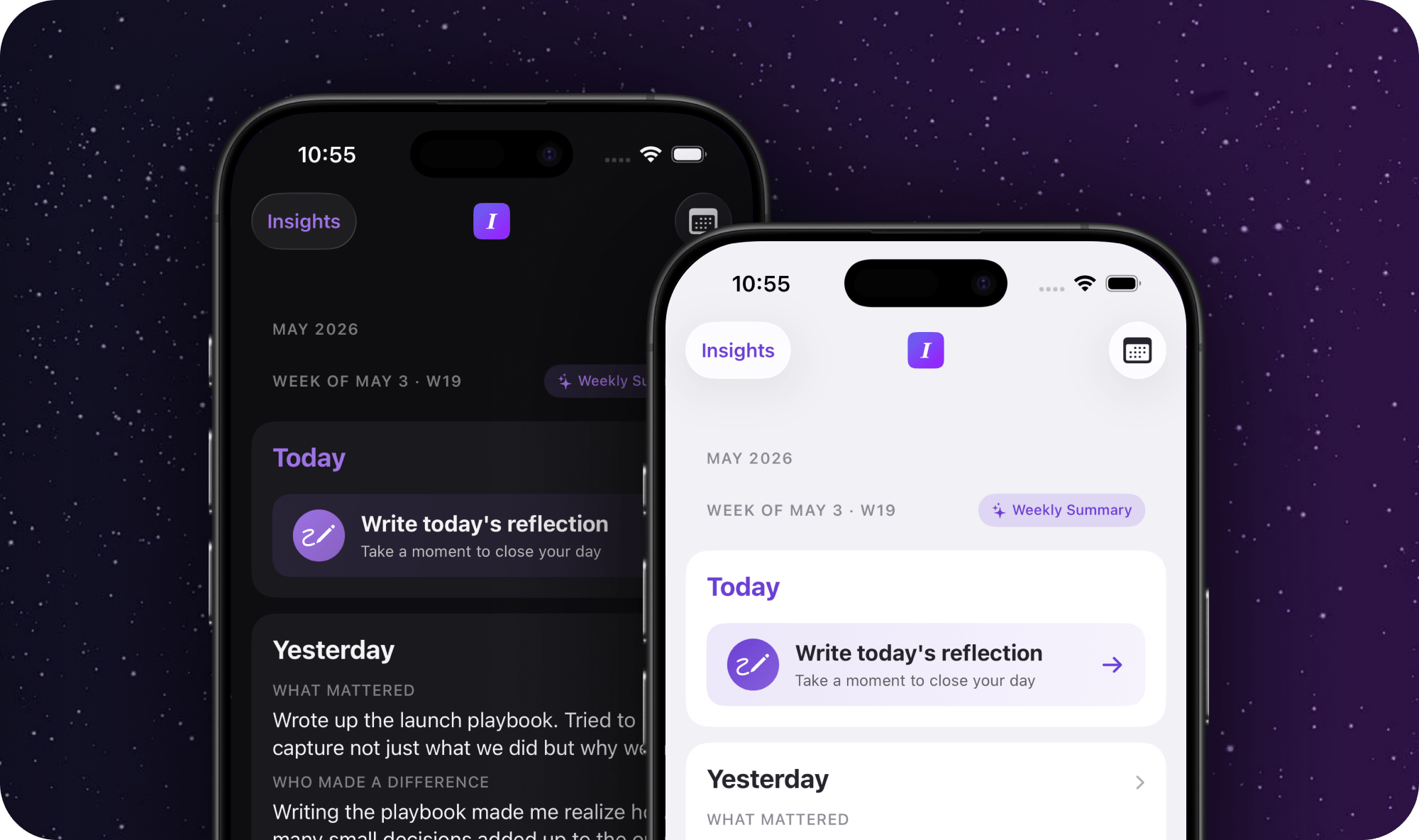
Intura is built for exactly this. Daily reflection prompts designed for managers. A weekly AI summary that surfaces patterns from your entries. And complete privacy: everything stays on your device and in your personal iCloud. Nothing on company infrastructure.
That 1:1 I mentioned at the top? The one where I couldn't remember what we'd talked about? I've had it again since then, but it went differently. I'd written three sentences the night before about a conversation that hadn't landed. When I sat down, I had the detail. The 1:1 was better for it. That's the whole pitch for reflection, really. Not a grand transformation. Just the detail you'd otherwise lose.
Frequently asked questions
Is management reflection the same as journaling?
They overlap, but they're not the same. Journaling can be anything: personal, emotional, creative. Management reflection is narrower on purpose. You're reviewing specific decisions, conversations, and patterns from your work as a leader. Intura is built for that narrower thing, not general journaling.
How long does a reflection session take?
A couple of minutes on most days. You answer a few questions about what mattered, who mattered, and what's still on your mind. The weekly review takes a bit longer, maybe five minutes, because you're reading back through your entries. If it takes longer than that, you're overcomplicating it.
When's the best time to reflect?
Right after your last meeting, or on the commute home. The trick is tying it to something that already happens every day so you don't have to remember. Morning works too, but you lose the detail. What you remember about a conversation the next morning is already less accurate than what you'd capture that evening.
Do I need to write a lot?
No. Short and specific beats long and vague every time. Something like: 'Had a hard conversation with Maya about the project timeline. She seemed more worried about visibility than the deadline itself. Follow up on that.' That one note is more useful than three paragraphs of processing.
What if I don't know what to reflect on?
That's exactly why prompts help. Staring at an empty text field every day is exhausting. Intura asks the same questions each time: What mattered? Who mattered? What's still on your mind? The structure makes the whole thing faster and actually useful.