A few months ago I talked to a designer who had been at the same level for three years. Strong performer, respected by the team, consistently delivered. Her last promotion conversation ended with "you need more visibility." She didn't know what that meant, and her manager couldn't really explain it either.
When I asked what she'd done in the past quarter, she gave me a rough summary. Good outcomes, nothing specific. She couldn't remember the details of the decisions she'd made, the people she'd unblocked, or the moments where she'd quietly prevented something from going wrong. That work had happened. It just wasn't anywhere.
The visibility problem isn't that ICs don't do visible work. It's that they don't have a record of it. And without a record, the promotion conversation becomes a negotiation about impressions rather than evidence.
Why ICs struggle to get promoted
Managers have a structural advantage in promotion conversations. Their work is observed more frequently by the people making promotion decisions. Their 1:1s, team health, and headcount outcomes are visible. ICs are often doing equally important work in ways that are harder to see: the stakeholder conversation that realigned a project, the Slack thread that unblocked a cross-team dependency, the decision that saved three weeks of rework.
None of that shows up in a meeting someone else attended. It shows up, if at all, in the memory of the person who did it. And memory gets unreliable fast. A 2015 study by Murre and Dros, replicating Ebbinghaus's forgetting curve, found that recall of specific episodic detail drops sharply within days. By the time a performance review rolls around, most of what actually happened is gone.
What gets remembered is general: "she's really strong," "he's a great collaborator." What gets forgotten is specific: "she caught the race condition in the payment flow before we shipped," "he spent two days working through the data model with the junior engineer." The general impression is what people carry. The specifics are what actually make the case.
What to capture as an IC
Most journaling advice is too broad to be useful. "Write about your day" doesn't tell you what to write. As an IC, there are four things worth capturing consistently:
- What you contributed or advanced. Specific, not general. Not "worked on the project" but "got the three teams aligned on scope and locked the timeline." If you can describe it in one sentence, you're being specific enough.
- Who you helped or collaborated with, and how. Unblocking someone, pairing on a problem, giving feedback on a design, reviewing a doc. These are influence moments. They're often what distinguishes someone at the current level from someone ready for the next one.
- Decisions you made or were part of. Even small ones. What you chose, what you traded off, and why. This is the thing that's hardest to reconstruct later and most useful to have when you're talking about your scope of judgment.
- What's still unresolved. Open threads, blockers, things that need follow-up. Not for accountability. For continuity. When you review your entries before a 1:1 or a promo conversation, you want to see what you were navigating, not just what you finished.
How reflection connects to promotion
Promotion conversations go better when you can answer specific questions specifically. "Tell me about a time you influenced a decision without authority." "What's an example of you operating at the next level?" Most ICs stumble here not because they can't think of an example, but because they can't recall a specific one under pressure.
Daily entries fix this. After three months of consistent reflection, you have a searchable log of your actual work. Before a promotion conversation, you spend twenty minutes reading your entries and pulling out the moments that map to the promotion criteria. You walk in with five specific examples. You don't have to perform recall under pressure. You're reviewing notes.
The same applies to 1:1s with your manager. When you surface specific work in those conversations (not "I've been busy" but "I unblocked the payments team on the webhook integration and we shipped it Wednesday") your manager has something concrete to carry into rooms you're not in. That's the mechanism behind visibility. It's not self-promotion. It's precision.
Building the habit
- Attach it to a transition, not a time. The moment you close your laptop, leave your last meeting, or wrap up for the day. Transitions that already happen reliably are more robust triggers than calendar reminders.
- Keep it to three questions. What did I contribute today? Who did I work with or unblock? What's still open? Answer each in a sentence or two. The goal is a record, not a meditation.
- Do a weekly read-through. Five minutes, once a week, reading everything you wrote. This is where the habit starts paying off. You see patterns you couldn't see day by day: a recurring blocker, a collaboration thread that needs follow-up, a type of work that's consistently energizing or draining.
- Flag entries worth keeping. When something happens that clearly maps to a promotion criterion (you made a hard call, you resolved a conflict, you shipped something with cross-team impact) mark it. These are your evidence file for the conversation you'll eventually need to have.
What this looks like in practice
| Without reflection | With reflection |
|---|---|
| "I've been really heads-down on the infra work" | "I identified the scope risk in the vendor integration, flagged it early, and got the timeline adjusted before it became a problem" |
| "I think I've been operating at the next level" | "Here are three specific decisions I made in the last quarter where I acted with senior judgment" |
| "I collaborate well with the team" | "I unblocked two teams this month by connecting the right people and clarifying requirements before they stalled" |
| Blank during the "tell me about a time" question | Two or three specific examples ready, recalled from notes, not improvised |
The compounding effect
The designer I mentioned at the start has been reflecting daily for about six weeks now. She sent me a message last week. She'd gone back through her entries before a 1:1 and surfaced five things her manager hadn't known about. Not because she'd done them secretly, but because they'd never come up.
The work was always there. What changed was the record.
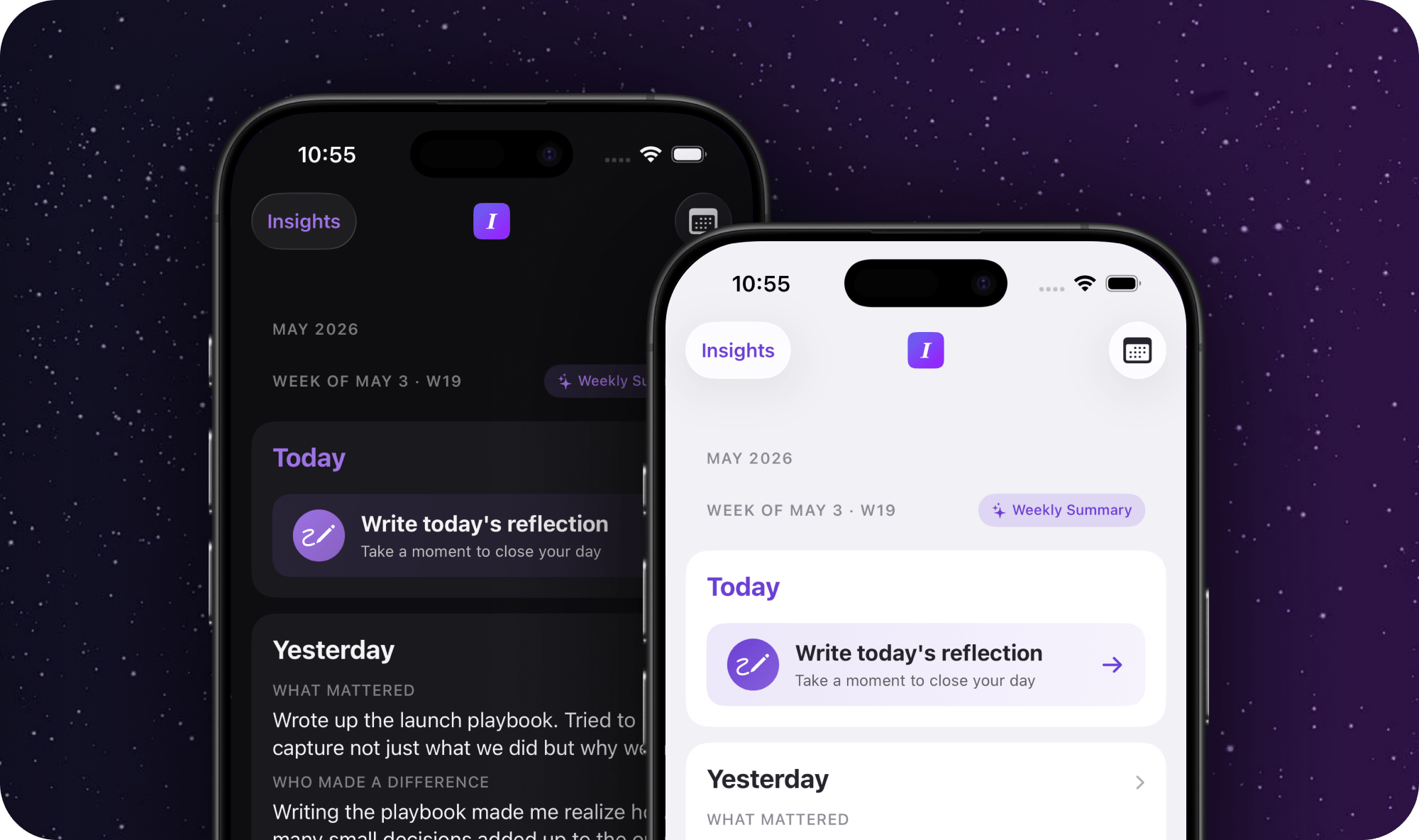
Intura is designed for exactly this: short daily prompts built around your work, a private record on your device, and an AI coach that helps you spot patterns across weeks. The IC mode, launched in April 2026, shapes the prompts and coaching specifically around individual contributors: the influence, impact, and career navigation that don't show up in a team health metric.
Promotion conversations are easier when you have evidence. Evidence requires a record. The record requires about two minutes a day. That's the whole system.
Frequently asked questions
Do I need to journal every day for this to work?
No, but more frequently is better. Even three times a week gives you a record you can actually draw on before a promotion conversation. The key is capturing impact while it's still fresh, not waiting until review season and trying to reconstruct six months of work from memory.
What if my work is hard to quantify?
Most IC work is. You don't need numbers for this to be useful. 'Unblocked the team by finding the gap in the requirements that no one had caught' is more useful than a vague metric. Specificity beats quantification. Write what happened, not just what changed.
How is this different from a brag doc?
A brag doc is a periodic retroactive list. This is ongoing capture. The difference is resolution: daily reflection catches things that would never make it into a brag doc because by the time you sit down to write one, the details are gone. You end up with better raw material for the brag doc, but the habit itself is more useful than the artifact.
My manager doesn't seem to notice what I do. Will journaling help?
Indirectly, yes. Journaling makes your work visible to yourself first, which changes how you talk about it. When you can recall specifics (the decision, the tradeoff, the person you helped) you start surfacing your work in 1:1s and status updates naturally. You're not bragging. You're reporting with precision.
What's the right length for a daily entry?
Short. Answer three questions: what did I contribute today, who did I work with or unblock, what's still unresolved. Two or three sentences per question is plenty. You're building a log, not writing an essay.