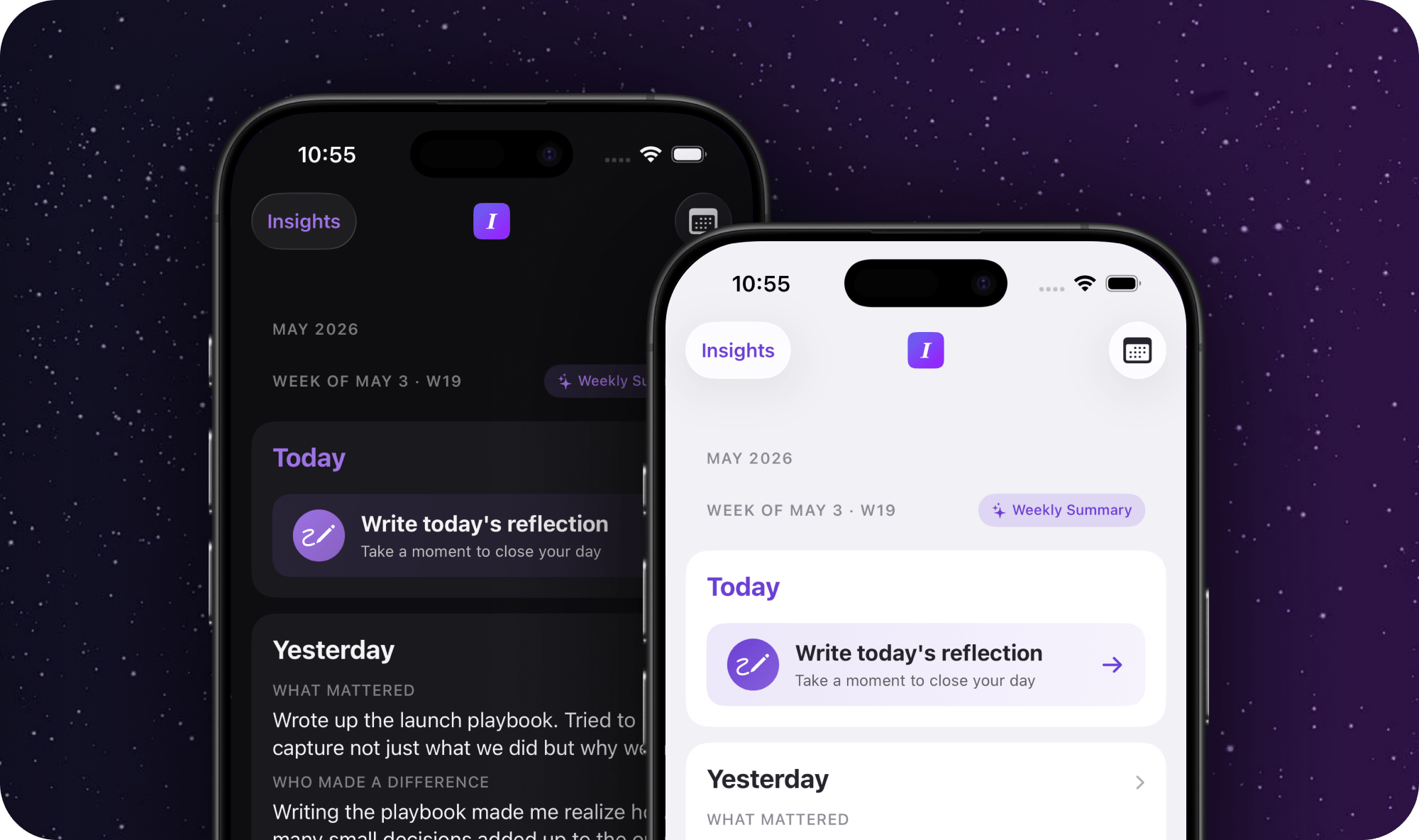
I've watched a lot of managers try to start a reflection habit. Most of them keep it up for about ten days. Then it quietly disappears, not because they decided to stop, but because one busy afternoon turned into two, and then it was just gone.
The ones who stick with it do three things differently: they tie it to something that already happens every day, they answer the same few questions each time, and they keep it short. The problem is never motivation. It's friction. Remove the decision of what to write and when to write it, and the habit forms on its own.
Why reflection habits fail for managers
The failure pattern is almost always the same. Blank page, no trigger, no constraint.
- The blank page problem. You open an app with no prompts and have to decide what to write about. That decision, repeated daily, is exhausting. Most days you'll close the app without typing anything.
- No fixed trigger. "I'll reflect sometime today" is an intention, not a habit. Intentions disappear under workload. What converts intention into habit is a trigger: a specific moment you attach it to.
- No time limit. The feeling that you should write more is the enemy of doing it at all. A brief reflection every day is worth more than a thirty-minute session you do twice a month.
How to build the habit
- Pick a transition, not a time. The end of your last meeting. The moment you close your laptop. The start of your commute. These are things that already happen reliably. A calendar reminder at 6pm is fragile. A transition you can feel is robust.
- Answer the same questions every day. Kill the blank page entirely. What mattered today? Who mattered? What's still on your mind? Same questions, no variation. The repetition is the point.
- Set a ceiling, not a target. One sentence per question is fine. On days when you have more to say, you'll write more naturally. But the expectation should be brief, not comprehensive. This is the single most important thing for making it last.
- Decide about weekends before you start. Some managers reflect on weekends, some don't. Either is fine. Just decide up front so you don't spend every Saturday feeling vaguely guilty. Weekdays only is a perfectly valid choice.
- Add a weekly read-through. Once a week, spend five minutes reading your entries from the past seven days. You're not writing anything new, just reading. This is where the individual entries turn into something bigger. Patterns you couldn't see one day at a time become obvious across the week.
What the weekly review reveals
A single entry gives you useful context. But across a week, the entries become evidence. A 2014 Harvard Business School study by Di Stefano, Gino, Pisano, and Staats found that employees who spent 15 minutes reflecting at the end of the day performed 20 to 25 percent better than those who didn't. You notice you mentioned the same person three times without resolution. That a certain type of meeting reliably drains you. That a decision you thought was made keeps showing up because it isn't actually settled.
None of that comes from any one entry. You need the full week as a data set. The weekly review is when the habit starts paying off beyond simple recall.
Habit formation timeline
The first two weeks feel effortful. You're still making an active choice each time. Research by Phillippa Lally and colleagues, published in the European Journal of Social Psychology (2010), found that habit formation takes an average of 66 days. By week three or four, most managers say it starts feeling like something's missing when they skip it. By week eight or nine, it's usually automatic.
Intura is designed to speed this up. The prompts eliminate the blank page. The short format keeps it sustainable. And the weekly AI summary surfaces patterns from your entries automatically, so you don't have to do the synthesis yourself.
The managers I mentioned at the top, the ones who quit after ten days? The difference between them and the ones who stuck with it was never discipline. It was whether they'd removed enough friction to survive a bad week. If you can answer three questions in two minutes on your worst day, you'll still be doing this in six months.
Frequently asked questions
How long should a daily reflection take?
Two minutes, tops. Answer a few focused questions about your day: what mattered, who mattered, what's still on your mind. If you find yourself writing for ten minutes, that's fine once in a while, but don't design around it. The habit needs to be short enough that you'll actually do it on a bad day.
What happens if I miss a day?
Nothing. Just reflect the next day. This isn't a streak. Missing one day doesn't erase the value of everything else you've written. The guilt about missing is honestly more damaging to the habit than the gap itself.
Morning or evening: which works better for reflection?
Evening, or whenever your workday ends. You capture same-day detail while it's still accurate. By the next morning, your memory of a specific conversation has already shifted. Morning reflection is fine for planning and setting intentions, but it doesn't replace capturing what actually happened.
I've tried journaling before and always stopped. Why would this be different?
Probably because you were staring at a blank page. Having to decide what to write about every single day is exhausting, and that decision fatigue is what kills the habit. Manager reflection with specific prompts takes that decision away. Same questions, every day. The constraint is what makes it stick.
Do I need a special app, or can I use a notebook?
Either works. A notebook is private and has zero friction to open. The trade-off is that spotting weekly patterns is harder when you have to flip back through pages and synthesize manually. An app like Intura does that synthesis for you with AI, which is the main reason to go digital.